

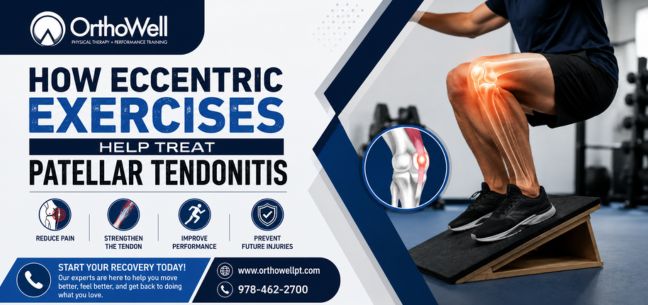
How Eccentric Exercises Help Treat Patellar Tendonitis
Patellar tendonitis, often known as jumper’s knee, is a common injury that causes pain in the tendon connecting the kneecap to the shinbone. It frequently affects athletes who participate in sports that involve jumping, sprinting, or sudden changes in direction. However, it can also develop in active adults who place repeated stress on their knees during work or exercise.
Eccentric exercise training is one of the best treatments for patellar tendonitis. Physical therapists frequently prescribe these exercises to build tendon strength, reduce pain, and improve knee function without simply resting or relying on medications.
What Are Eccentric Exercises?
Eccentric exercises focus on the lengthening phase of a muscle contraction. Instead of concentrating on lifting a weight, the emphasis is placed on slowly lowering or controlling a movement.
For example, when performing a squat, the lowering phase is considered the eccentric portion of the exercise. During this movement, the quadriceps muscles remain active while gradually lengthening to control the body’s descent.
This type of controlled loading places a specific stress on the patellar tendon, encouraging it to adapt and become stronger over time.
Why Eccentric Exercises Work for Patellar Tendonitis
Promote Tendon Healing
If the tendon becomes irritated (overuse stress), the collagen fibers may get disorganized. Eccentric exercises also stimulate tendon cells to produce more collagen, stimulate the healing of tendons, and help make them healthy.
As time goes on, the tendon will be able to more easily sustain physical strain, and the chances of further irritation will be lessened.
Reduce Pain
Many people with patellar tendonitis avoid movement because of discomfort. However, complete rest is rarely the best solution.
Research and clinical experience have shown that controlled eccentric loading can help decrease pain sensitivity within the tendon. As the tendon adapts to the exercise program, everyday activities such as walking, climbing stairs, and exercising often become more comfortable. Learn more about the benefits of eccentric exercise for knee pain relief.
Improve Load Capacity
Healthy tendons are designed to absorb and release force. Patellar tendonitis can reduce this ability, making sports and physical activities difficult.
Eccentric exercises slowly load the tendon with controlled stress and allow the tendon to develop tolerance and strength. This helps the tendon to handle greater activity without being overwhelmed.
Enhance Knee Stability
Strong muscles and proper movement patterns play an important role in protecting the knee joint. Eccentric training improves neuromuscular control, balance, and coordination, which can help reduce unnecessary stress on the patellar tendon during movement.
Effective Eccentric Exercises for Patellar Tendonitis
Decline Board Squats
Decline board squats are widely used in rehabilitation programs for jumper’s knee.
To perform this exercise:
- Stand on a decline board or slant surface.
- Slowly lower into a squat over three to five seconds.
- Keep your movements controlled.
- Return to the starting position carefully.
- 3 sets of 10-15
- Frequency depends on age and tissue tolerance, from 3x/week to daily
This exercise places focused stress on the patellar tendon and encourages tendon adaptation.
Single-Leg Eccentric Step-Downs
This exercise helps improve strength and control around the knee.
Steps include:
- Stand on a step or platform.
- Slowly lower the opposite foot toward the floor.
- Take three to five seconds to complete the lowering movement.
- Return to the starting position and repeat.
- 3 sets of 10-15
- Frequency depends on age and tissue tolerance, from 3x/week to daily $.
Maintaining proper form is more important than speed.
Tips for Better Results
Consistency is key to the best results. Regular eccentric exercises for several weeks are recommended by most rehabilitation programs. It takes time for tendons to heal, and it may take some time before they become noticeable.
Some discomfort during exercise may be acceptable, but exercise should be avoided if the pain is severe or sharp. There should also be a progression that is slow. Strength will increase, and resistance or difficulty of the exercise can be increased as well to keep it challenging, safely.
When to Seek Professional Help
If knee pain continues to limit your activities, it may be time to consult a physical therapist. A professional evaluation can identify movement problems, muscle imbalances, and other factors that may be contributing to your symptoms.
Individualized rehabilitation programs at OrthoWell Physical Therapy are tailored to aid patients in recovering from tendon injuries, improve movement quality, and safely return to the activities that they enjoy.
Take the Next Step Toward Recovery
Persistent knee pain shouldn’t keep you from an active lifestyle. If you have symptoms of patellar tendonitis, talk to a trained physical therapist for a customized treatment plan and kick your way to healthier, stronger knees.
Final Thoughts
The eccentric exercises are regarded as one of the most effective treatment methods for patellar tendonitis, as they directly target the tendon and increase its strength, function, and movement control. Many people can alleviate pain, improve performance, and resume their favorite activities with confidence by following a structured program and taking it step by step.